
Tipflation in Germany and Europe: Why forced tipping at the terminal backfires
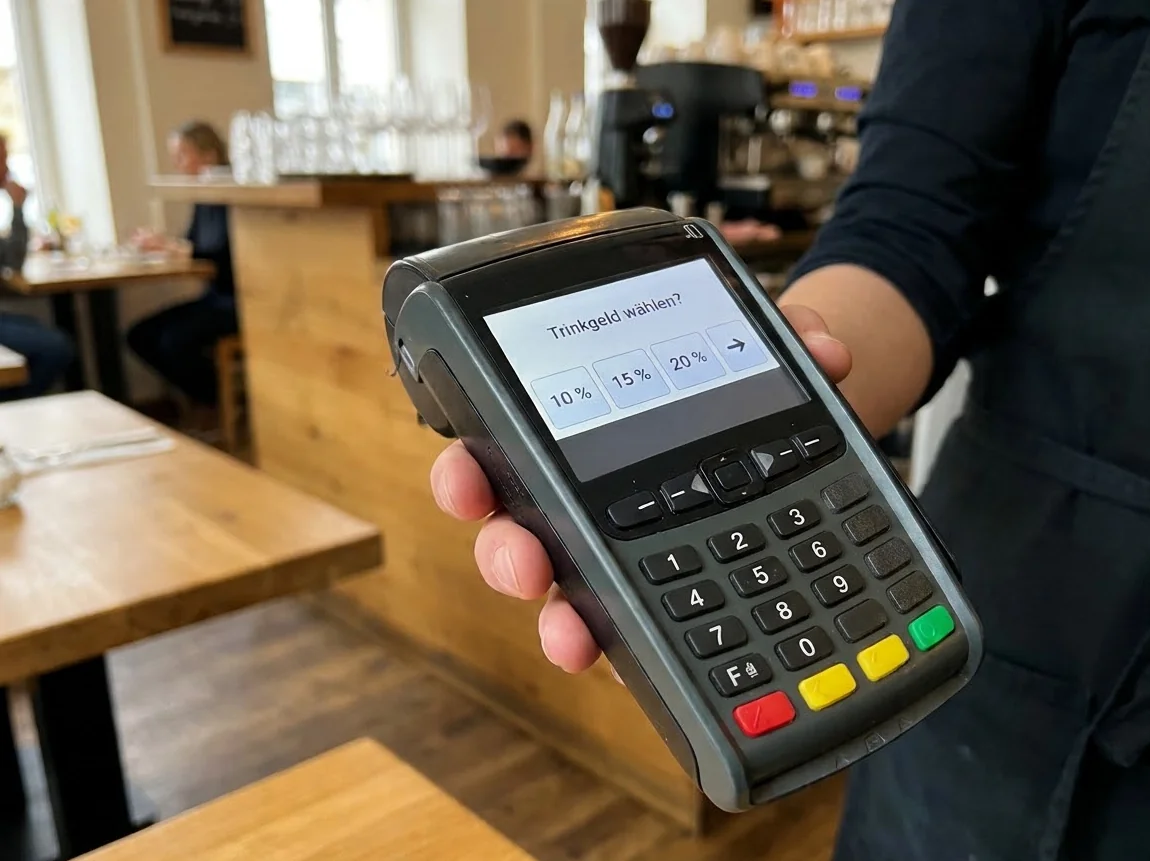
A quick coffee at the counter, self-service at the bakery, or paying at the till: before the card even touches the reader, the display asks about 15%, 20% or 25% tip. Right in front of the person behind the counter and the queue behind them. A term has emerged for this phenomenon, one that increasingly annoys guests and puts restaurateurs in a dilemma: tipflation.
What was once intended as a well-meaning digitisation of tipping now feels like a hidden surcharge to many people in Germany and Europe. The problem is not digital tipping itself, but the attempt to transfer American payment mechanics onto European service culture without reflection. Any business that wants to understand how cashless tipping works without driving loyal guests away must grasp the crucial difference between social pressure and genuine voluntariness.
What does tipflation mean, and why is the debate heating up now?
The term tipflation combines tip and inflation. It describes two developments that reinforce each other. First, the expected percentages are rising: where Europe long expected 5 to 10 percent, some terminals now suggest 15, 20 or even 25 percent. Second, tipping prompts are spreading into areas that traditionally had no tipping at all. The self-service coffee shop, the takeaway bakery, the kiosk, or the concept store with its own card terminal: the same question about a surcharge now appears everywhere.
From a gesture of thanks to guilt tipping at the till
What began as voluntary recognition for good service turns into a decision under observation at the terminal. The guest stands at the till, the server watches, and a queue waits behind them. The screen offers generous percentage buttons, while the "no tip" option is often small, hidden, or at least far less prominent. Researchers call this pattern a dark pattern: a design that nudges people subtly toward a direction they might not choose of their own accord.
The resulting effect has come to be known as guilt tipping: tipping out of a bad conscience. The guest does not give because they want to say thank you, but because saying "no" in that situation would feel awkward. That tip feels different for both sides: not like appreciation, but like a small defeat. Whoever parts with money this way remembers the moment, and rarely fondly.
Why software defaults make the problem worse
Technology itself compounds the situation. Many modern point-of-sale systems and payment terminals originate in the Anglo-American market or use international standard templates whose percentage defaults are tailored to the US. The presets are therefore not an expression of a European tipping culture but an import. Restaurateurs often adopt these presets unchanged, because they seem practical and the configuration is only a few clicks away. That the software sends a completely different message to guests in Germany, Austria or Switzerland than in New York often goes unnoticed.
USA vs. Germany and Europe: two fundamentally different tipping cultures
To understand why tipflation in Europe meets so much resistance, it helps to look at the USA. There, tipping is not a bonus but a fixed part of pay. This structural difference explains almost the entire misunderstanding.
Pay structure as the main difference: subsistence vs. appreciation
In the USA, service pay rests on the so-called tipped minimum wage system. The statutory base wage for staff who receive tips is significantly lower, because lawmakers assume the gap will be covered by tips. Service staff there depend economically on guests tipping. A missing tip means real lost income in the USA, and that is precisely why the social expectation is so strong.
In Germany and Europe, it works the other way round. Statutory minimum wages, collective agreements and social insurance systems secure the base income. The service is already included in the final price, and tipping is legally and culturally a voluntary bonus for exceptional service. This logic shapes guests' expectations: whoever already pays for the service does not want to be asked to pay a second time, at least not under pressure.
Why European guests react to pressure with rejection
In Germany, Austria, Switzerland and much of Europe, the unwritten rule is 5 to 10 percent, or simply rounding up, for good service. That rule is flexible: it depends on the situation, the occasion and personal judgement. If a guest is instead pushed toward 20 percent at the terminal, the mood shifts. The impulse to say thank you turns into a feeling of being caught off guard. The guest experiences the prompt not as an offer but as paternalism, and reacts accordingly.
| Criterion | USA | Germany and Europe |
|---|---|---|
| Pay structure | Tipped minimum wage; tips are part of income | Minimum wage and collective agreements secure base income |
| Typical amount | 15 to 25 percent, sometimes more | 5 to 10 percent, or rounding up |
| Expectation | Tipping is considered obligatory | Tipping is voluntary appreciation |
| Tax logic | Tips are taxed and part of payroll | Tips can be tax-free under conditions (§ 3 No. 51 EStG) |
| Role of the terminal | Percentage presets reinforce the expectation | Percentage presets feel like a hidden surcharge |
The hidden risks for hospitality, hotels and service businesses
Tipflation is not purely a consumer issue. For businesses, it translates into concrete commercial risks that reach far beyond the individual payment.
1. Backlash: guests stop tipping out of principle
Whoever feels patronised presses "0%" on purpose, even if they would happily have given two or three euros. Pressure at the terminal therefore produces the exact opposite of what it intends: instead of more tips, the team ends up with a worse result than it would get from a relaxed, voluntary decision. The arithmetic is sobering. A single defensive reaction at the terminal can wipe out the return of an entire order, and the server never even notices.
2. Worse reviews and a declining return rate
The uncomfortable moment lands in a strategically poor spot: at the very end of the visit. The peak-end rule from behavioural psychology holds that people judge an experience mainly by its peak and by its ending. A good meal and attentive service fade if the last impression was an uncomfortable tipping prompt. That moment shows up in Google reviews, gets retold in conversation, and influences whether a guest comes back. The damage is done not at the terminal but weeks later in the review.
3. Tax and accounting traps from mixed terminal revenue
When tips are collected through the ordinary card terminal, they first land in the merchant account, mixed with regular revenue. Without clean separation and clear attribution to staff, things get complicated. Tax exemption under § 3 No. 51 EStG requires the tip to be given voluntarily, directly for a service and in addition to wages. If the system can no longer show later which amount is owed to whom and for what reason, significant effort lands on the tax advisor. What is actually a tax-free benefit quickly becomes an audit issue.
The way out of the tipflation trap: voluntary digital tipping without pressure
The good news: there is no need to abandon digital tipping, only to implement it differently. Digital tipping without pressure emerges when you step away from the American terminal logic and take the needs of European guests seriously. Three levers are decisive.
Decouple the payment process from the tip
The most effective step is structural: the tip does not belong in the stressful checkout moment. Instead of pressing it into payment at the terminal, enable discreet QR code or NFC touchpoints on the table, in the bill folder, in the hotel room or on staff cards. The guest decides calmly with their own smartphone, at their own pace and without observation. They can choose the amount, leave a message, or skip it, all without anyone watching. This decoupling is exactly what removes the social pressure, and genuine voluntariness grows from it.
European amounts instead of American percentage traps
Decoupling also means choosing the right amounts. Instead of aggressive 20% prompts, small, realistic euro amounts work in Europe, such as 2 €, 5 € or 10 €. Alternatively, moderate 5 to 10 percent can be combined with a free custom amount. The guest recognises the logic they know, instead of having to operate a foreign model. A well-chosen suggestion feels like a polite invitation; a high percentage feels like a demand. The difference is only in the design, yet it decides the reaction.
Direct attribution to the team instead of an anonymous till prompt
When guests see whom their tip benefits, their willingness to give rises. The specific server, housekeeping or the shift team receives a visible contribution instead of an anonymous till prompt. As a side effect, this attribution cleanly fulfils the requirements for the tax exemption of digital tips under § 3 No. 51 EStG, because it is clear for which service the amount was paid and to whom it belongs. Transparency toward the guest and tax order go hand in hand here.
Conclusion: three rules for fair digital tipping in Europe
Tipflation does not arise because guests do not want to give, but because the way they are asked gives them the feeling of having no real choice. For businesses introducing digital tipping or rethinking existing terminals, the key insights come down to three rules.
- Keep voluntariness visible. No hidden "no" button, no social pressure at the counter. An honestly designed choice respects that a guest may also say thank you with "no".
- Respect the context. Table service, hotel rooms or personal advice invite tipping more readily than a pure self-service checkout. Adapting the prompt to the moment and the situation meets the expectation instead of violating it.
- Choose clean technology. Separate payment flows so that the tip reaches the team directly, quickly and tax-free. That is exactly what we built Tipflow – our solution for digital tipping for: decoupled from the checkout moment, with realistic amounts and clear attribution to the team.
European guests are willing to recognise good work. They are simply not willing to be pressured into it. Whoever respects that boundary earns trust, and in the end more tips as well.
Topics
- Tipflation
- Trinkgeld
- Kartenterminal
- Deutschland
- Europa